


Innovative AI-Based Simulator for Teaching and Assessment: From Medical Ethics to a Broad Educational Platform
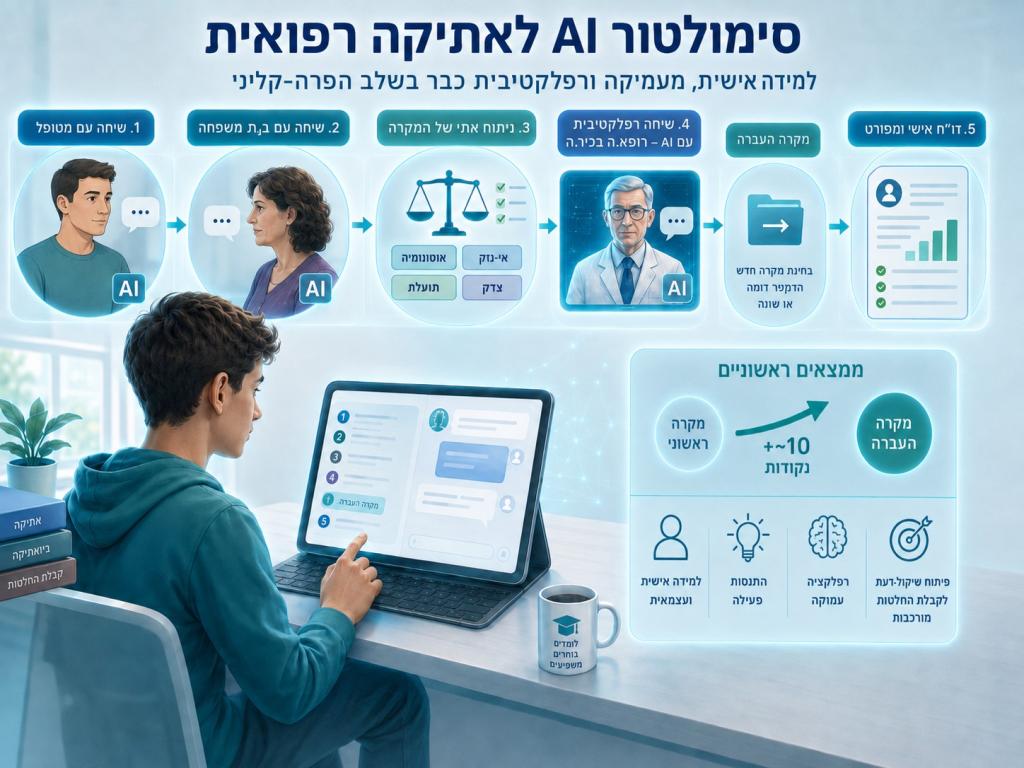
An innovative simulator for teaching medical ethics, developed by Prof. Miri Bentowitch, a bioethics researcher at the Azrieli Faculty of Medicine, in collaboration with Prof. Ayelet Arbel-Eden, Head of the Medical Education Unit, offers students a personalized and immersive learning experience.
Built using the BASE44 vibe-coding environment, the simulator guides learners through conversations with a patient and a family member, ethical analysis of the case, and a reflective discussion with an AI-powered senior physician. Learners then tackle a new "transfer case" designed to assess their ability to independently apply the principles and insights gained during the initial experience.
"The advantage is that each student engages in an extended process of conversation, decision-making, ethical reasoning, and reflection, rather than simply participating in a group discussion," explains Prof. Bentovitch. "This enables more personal, active, and meaningful learning."
At the end of the exercise, the system generates a detailed personalized report highlighting strengths and areas for improvement, extending the learning process beyond the simulation itself. Preliminary findings among students in both the four-year and six-year MD programs are particularly encouraging: performance improved by an average of approximately 10 points from the initial case to the transfer case, a statistically significant gain.
The platform's potential extends well beyond ethics education. Its modular structure, combined with direct development in a vibe-coding environment, allows relatively rapid adaptation to entirely different subject areas and instructional needs. For example, an initial prototype for a pre-clinical immunology course was recently developed in significantly less time than was required to create the original ethics simulator.
Another key advantage is the platform's AI-driven assessment capability, which can generate detailed, context-sensitive evaluations and feedback. This feature may become increasingly valuable as student enrollment grows, helping maintain high-quality assessment and feedback at scale. Broader implementation of the system will be contingent upon a formal validation process for the scores and evaluations it produces.
Last Updated Date : 17/09/2026