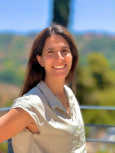
Dr. Tal Binyamin
When and where did you complete your degree?
I completed my PhD in the laboratory of Dr. Ronit Ilouz at the Azrieli Faculty of Medicine at Bar-Ilan University. I joined the Faculty after completing my master's degree at Bar-Ilan University, driven by a desire to return to northern Israel, the region where I grew up, the Golan Heights.
For me, choosing to pursue a PhD at the Faculty was an opportunity not only to continue engaging in research, but also to return to a region that feels like home. Looking back, my years at the Faculty were far more than just another stage in my academic journey; they provided a meaningful foundation for both my professional and personal development.
Where are you today, and what are you working on?
Today, I teach science courses in higher education and serve as the director of an Academic Center for Youth that focuses on connecting academia, science, and healthcare systems. At the same time, I am pursuing an MBA with a specialization in innovation and entrepreneurship.
Alongside my work in science and education, I have developed a deep interest in management, innovation, and leadership. Today, I am increasingly involved in developing collaborations between healthcare and academic organizations, leading teams, and bridging scientific knowledge with strategic initiatives.
I feel that the intersection of science, people, management, and innovation is where I would like to continue to grow and develop.
How did your degree help you get to where you are today?
I am still at the beginning of my professional journey, but I can already see how my PhD continues to accompany me beyond the laboratory.
My research involved extensive collaboration with researchers and healthcare professionals and gave me valuable experience and confidence in building professional relationships, working collaboratively, and leading projects. These are skills that I continue to use in my work today.
My current involvement in teaching and communicating scientific knowledge to students also connects naturally to the experience I gained during my doctoral studies. Research greatly strengthened my ability to speak before an audience, present complex ideas clearly, and transform scientific knowledge into a tool that helps others learn and grow.
I believe that my future path will continue to intersect with research, and that all the experience I have gained- scientific, managerial, and interpersonal- will come together in a direction where I can make the greatest possible impact.
What is the best advice you can give students?
I began my PhD with a very clear goal: to complete a publication-based doctorate. The path was filled with challenges: unsuccessful experiments, failures, disappointments, and moments when it would have been very easy to doubt myself and the path I had chosen.
My best advice to students is not to be afraid of difficulties and not to view failure as a sign that you are on the wrong path. Sometimes it is דווקא the longer and more complex journey that builds the skills, confidence, and resilience needed for the future.
Today, I have completed a publication-based PhD and am nearing the end of the revision process for my third paper. I can confidently say that perseverance was worth it.
What significant experience from your degree would you like to share?
One of the most meaningful experiences for me actually occurred after the publication of my first paper, in 2024.
As part of the research, together with our laboratory and collaborators, we discovered the mechanism underlying a rare disease and named it NLPD-PKA, a condition characterized by neuronal loss and parkinsonism resulting from a mutation in the PKA enzyme.
Some time after the paper was published, I was contacted by a woman from the United States who had read our study. Her son had been diagnosed with autism, and genetic testing had identified a variant in the same PKA protein, although at a different location. She wanted to understand whether the findings from our research might also be relevant to her son's case.
Dr. Ronit Ilouz and I met with her and shared the knowledge available to us at the time. Later, additional families of children carrying similar variants in the same protein joined the effort. We were also able to connect with the physicians and researchers who had first identified those autism cases and variants.
Over time, a community was formed that brings together parents, physicians, and researchers from different parts of the world. Together with our laboratory, this community continues to advance research, collect information, and piece together more parts of the scientific puzzle.
For me, this was one of the most powerful demonstrations of the impact research can have. A scientific paper produced in a laboratory in Safed can reach a family thousands of kilometers away, create connections between people who otherwise would never have met, and become part of a genuine effort to understand a disease and perhaps offer these families a light at the end of the tunnel.
It is also one of the reasons I believe so strongly in the connection between research, medicine, and people.
What would you like to do next?
I want to find a path that allows me to combine all the worlds I am passionate about: researching, learning, managing, and leading.
I still cannot define the exact position or title in which all these elements will come together, but I do know the direction I want to pursue: creating connections between science, medicine, innovation, and people, and leading processes that can transform knowledge and ideas into action and meaningful impact.
Last Updated Date : 22/09/2026