


Beyond Sensation: Directing Attention to the Body Influences Immune Regulation
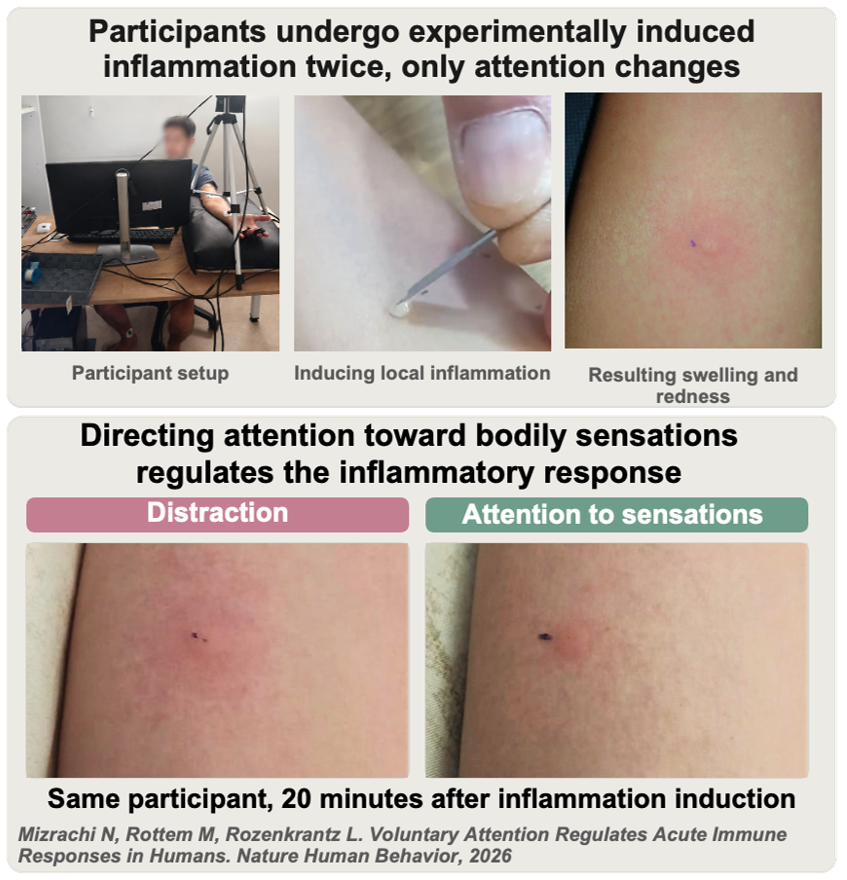
A new study from the laboratory of Dr. Liron Rozenkrantz at the Azrieli Faculty of Medicine, Bar-Ilan University, led by Dr. Nofar Mizrachi and conducted in collaboration with Prof. Menachem Rottem, a clinical immunologist, shows that the simple, everyday cognitive act of directing attention toward bodily sensations can influence, within minutes, how the body regulates an inflammatory response.
The study, published in Nature Human Behaviour, included a series of controlled experiments in which a localized inflammatory response was induced in the skin of healthy participants. Each participant visited the laboratory twice under identical conditions, with the only difference between sessions being the focus of attention: in one session, attention was directed inward, toward sensations arising from the inflamed area; in the other, attention was directed outward, toward an external stimulus. The same result emerged in two independent groups: when attention was directed toward the site of inflammation, the inflammatory response was smaller and more regulated than when attention was diverted away from the area. Overall, 90% of participants showed a more regulated inflammatory response when attending to the inflamed site.
In addition, when participants directed their attention toward the inflamed area, they reported stronger sensations, even though the inflammatory response itself was smaller. This finding raised the question of whether sensory information reaching the brain from the inflamed area contributes to regulation of the response. To test this, the researchers conducted an additional experiment in which they reduced sensory input from the skin using a local pharmacological anesthetic, while participants continued to direct their attention toward the inflamed area. Under this condition, the inflammatory response was larger than when participants attended to the area without anesthesia, but still smaller than when their attention was diverted away from it. In other words, sensory information from the skin contributed to the effect of attention, but did not fully explain it.
At the same time, the researchers found evidence pointing to an additional pathway: when attention was directed toward the inflamed area, participants showed greater heart rate variability, an indirect measure of parasympathetic-vagal activity that has been linked to the regulation of inflammatory responses. This difference remained even when sensory input from the skin was attenuated with local anesthesia before inflammation was induced. Taken together, the findings point to two complementary processes that may underlie the effect: one involving sensory information traveling from the inflamed area to the brain, and another involving autonomic regulation from the brain to the body.
The findings broaden our understanding of the role of attention beyond its well-established effects on subjective sensory experience, showing that attention may also participate in the physiological regulation of the body. They further suggest that a common and even clinically accepted strategy – distracting oneself from unpleasant sensations – may come at a cost to physiological regulation. The study was conducted in healthy adults using a localized, short-term model of skin inflammation under laboratory conditions. Whether, and how, attention can be harnessed in clinical settings and in other models of inflammation remains an open question and is currently being investigated in Dr. Rozenkrantz’s laboratory.
Paying Attention to the Body May Influence Inflammation: A new study from the laboratory of Dr. Liron Rozenkrantz at the Azrieli Faculty of Medicine, published in Nature Human Behaviour, found that directing attention toward an inflamed area of the body led to a milder inflammatory response within minutes. In a series of controlled experiments, approximately 90% of participants showed better regulation of inflammation when focusing on sensations arising from the affected area, compared to when their attention was directed elsewhere. The findings suggest that attention not only shapes subjective experience but may also play an active role in the physiological regulation of inflammatory responses in the body.
Last Updated Date : 17/09/2026